
Who Fails When Schools Fail? Practical Solutions to Nigeria’s Public Education Crisis
By Oluwatoyin Hawal Momolosho
Nigeria’s education system has become like a complex chess puzzle; those who don’t know the rules are trapped, and those who should guide them cannot even stand on their feet. A nation that proudly declares that “the youth are the leaders of tomorrow” seems unprepared to train those very leaders. In front of the younger generation, education is mocked as a scam, yet nothing meaningful has been done to restore its value.
Ironically, the same society later blames Nigerian youths for being unserious about their studies. But how can we blame them when the system itself has failed to inspire hope?
Who, then, is truly responsible for the development of education? Even if students lose their way, who should fight for their right to learn? When leaders neglect the training of the younger ones, who will speak truth to power? As Chief Obafemi Awolowo once warned, “The children of the poor you fail to train will never let your children have peace.”
Recently, I was working on a story about the poor state of classrooms and school buildings in a secondary school in Ilorin, Kwara State. I was contacted by someone from the school who asked me to help make their situation public so the government could be aware of their plight.
But surprisingly, despite being the ones who reached out, they were still afraid to grant an interview. Their fear spoke volumes. It revealed how the freedom that democracy promises has failed to protect those who wish to speak up. It showed how deeply the rot in Nigeria’s education system runs when even teachers and administrators feel unsafe to tell the truth about their own schools.
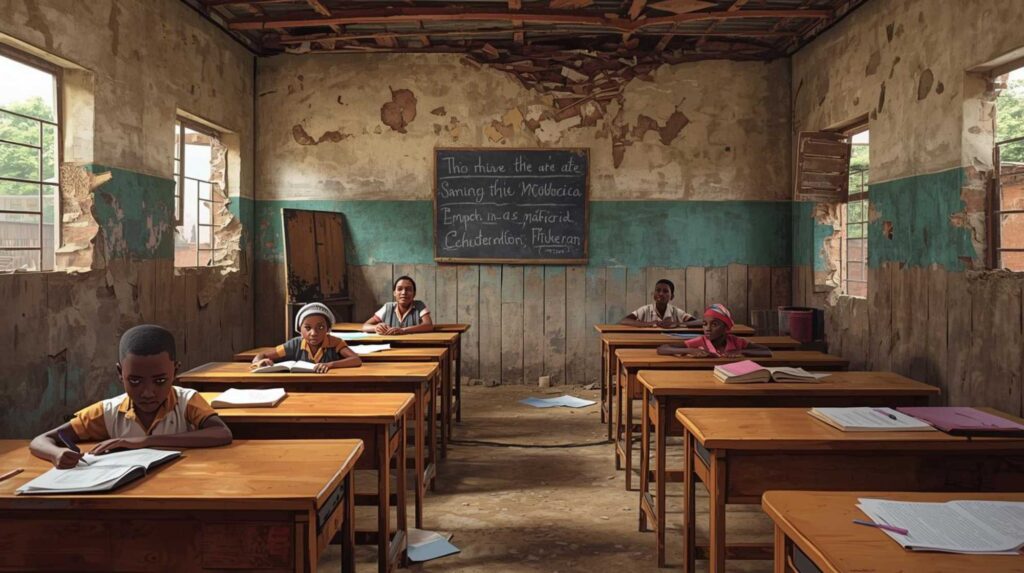
Unfortunately, the same students we call the “leaders of tomorrow” are studying in classrooms where the buildings are collapsing, where there is no roof, no doors, and not even windows to shield them from the sun or rain. Yet, we boldly claim that education is improving in this country. Teachers, who should be the pillars supporting these students, are themselves struggling. Often, without enough materials to teach or even the courage to speak out, for fear of losing their jobs. As a result, students lose focus, integrity, and faith in education.
How can they believe in a system that has stopped believing in them? Those in power continue to misuse the funds meant for education, sending their own children abroad while the poor are left behind in ruins. This growing inequality turns the promise of education into a privilege for the few, instead of a right for all.
However, it’s no longer news that Nigeria’s education system has been in crisis for decades, yet nothing has been done about it, and statistics not only tell us the number, it show the story of neglect and inequality in Nigeria’s education system.
According to Data gotten from UNESCO, it is detailed that over 18 millons of Nigeria children are out of school, which makes it one of the highest figures in the world. It showed that millions of young people who should be in classrooms are roaming about the streets, denied the chance to learn and contribute to their country’s future. In the northeastern region, where insecurity has worsened the situation, more than half of displaced children 56% do not attend school, and only 29% of schools there have teachers who meet the minimum qualification standards, according to UNICEF.
But the problem is not just about children staying out of school; it’s also about what happens inside the classrooms. The Universal Basic Education Commission (UBEC) reported that the national pupil-teacher ratio in Nigerian public primary schools is roughly 49 to 1, which means that nearly fifty pupils depend on a single teacher for attention and guidance in the classroom.
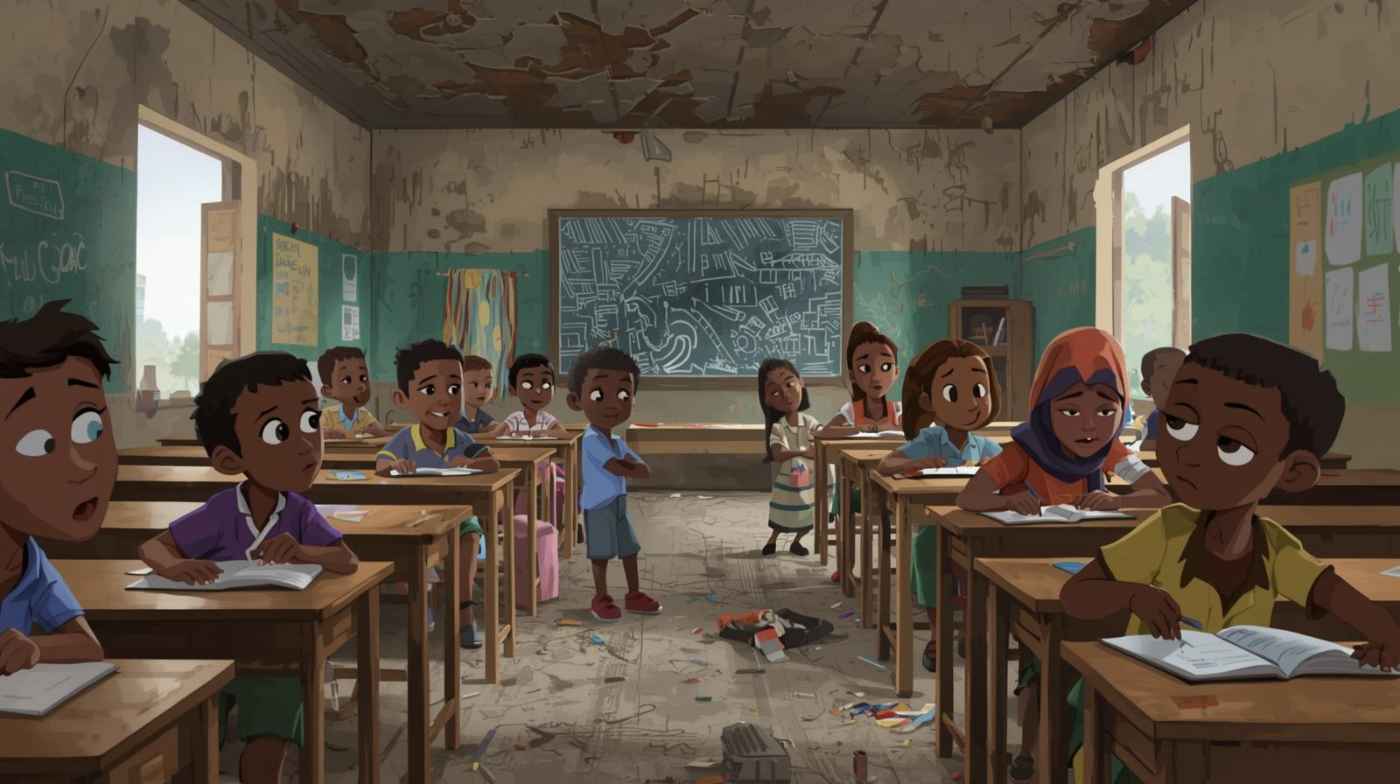
Also, in some rural schools, there may be only one or two textbooks for every five students with their teacher, and many students sit on the floor because their is no enough chairs in the classroom or have been broken, nothing like windows, and other things like a roof leaking, which would later bounce back on the students.
According to research, it showed that funding is also one of the biggest challenges. Despite repeated promises, the federal government continues to allocate less than 10% of the national budget to education, far below the UNESCO-recommended 15–20%. This chronic underfunding leaves schools without proper facilities, teachers unpaid for months, and communities forced to depend on charity to keep their schools alive. The result is a widening gap between the children of the rich, who can afford private schools or study abroad, and the children of the poor, who must learn in collapsing buildings.
Of course, this does not just hinder the knowledge of youth, but also changes their perspective to think that education is actually a scam. Remember, any student who denied quality education would think before the reality show that he would have become a doctor, engineer, or teacher that Nigeria would never have, but since Nigeria’s education system is not well mentored, such a student would end up in nothing close to his dream. Such a student is already failing even before school fails.
Fortunately, Nigeria’s education system can still be rebuilt, but only through deliberate and honest action. To make things up, the first step has to be adequate Funding and Transparency. The government needs to treat education as a national emergency by increasing the budget to at least the UNESCO benchmark of 15–20%.
However, that money must be used wisely with strict monitoring, public accountability, and digital tracking of school projects to prevent corruption and ghost spending.
Secondly, our country needs to invest in teachers, because no education system can rise above the quality of its teachers. Salaries should be reviewed regularly to meet the cost of living, and teachers should have access to continuous professional development and modern teaching materials. So, if teachers are trained well, paid properly, and given proper attention to the students, students would be able to learn, unlearn, and relearn.
Thirdly, school infrastructure development must be improved, especially in rural areas. Every child deserves a safe classroom with proper desks, roofs, and toilets. Meanwhile, the government has to create a great partnership with NGOs and private organizations that can help rebuild decaying schools, while communities can contribute to it for proper maintenance.
Furthermore, technology and innovation should be embraced. Low-cost digital tools, radio lessons, and solar-powered classrooms can help bridge the gap for children in remote areas. During the COVID-19 lockdown, some Nigerian states like Lagos proved that digital education is possible if well planned, and also created a smart board and taught students how to join class through their laptops and phones for easy education.
In conclusion, Nigeria’s curriculum must be reformed to prepare students for today’s world. Beyond memorizing facts, schools should teach problem-solving, digital skills, critical thinking, and entrepreneurship, skills that empower youths to create jobs rather than wait for them.
Meanwhile, if all these solutions can be adopted or implemented, the school won’t fail, or students will keep saying, “education na scam again.” Nigeria’s education system will return to normal, and it will be interesting that no students will fail to attend school because opportunities, empowerment, and easy learning have been provided.