FEATURE: Help! My Uncle is Kidnapped in Nigeria, By Haruna Mohammed Salisu
By Haruna Mohammed Salisu
Three weeks ago, my uncle did not come home.
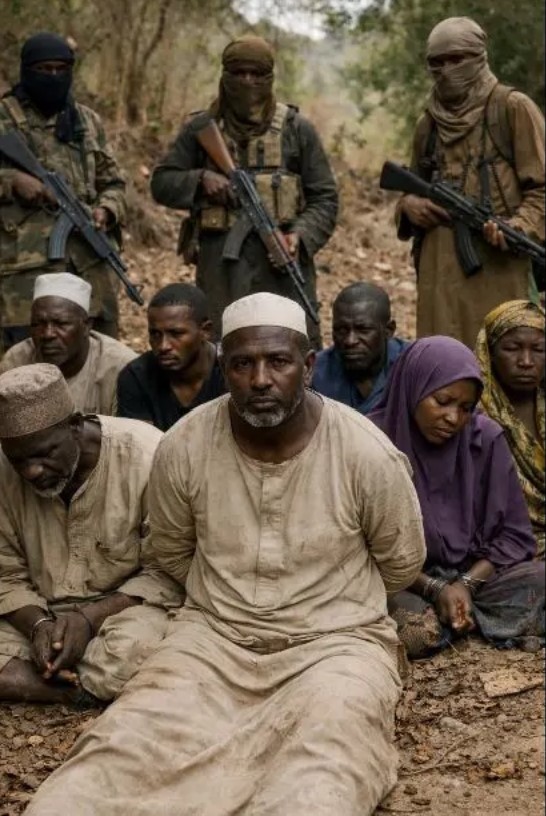
He had left at dawn, the way he always does. A poor man moving through the world before it fully wakes, returning to a family that waits for him. He did not return. Gunmen took him from the road, into a forest that stretches from Taraba, Plateau, and Bauchi, and they have kept him there ever since. As I write this, he is still in that forest. He is still alive. And we are running out of time.
My uncle is not a man of wealth or influence. He holds no government position, owns no land beyond what feeds his family, has no cousin in Abuja to call. He is a man who has spent his life in the honest arithmetic of survival — working, providing, asking for nothing beyond safety and the right to return home at the end of each day. He is the kind of man who, in a just world, the worst of the world would leave alone.
The worst of the world did not leave him alone.
When they first took him, the kidnappers were calculating. They had watched him. They knew what he owned, what he earned, what his family could plausibly raise. A man who has spent his life negotiating between hunger and enough does not present as a profitable target. So they held him.
Days became a week. A week became two. Two became three. And then, without warning, they changed their demand.
They are now asking for N100 million.
I want you to sit with that number for a moment. At Nigeria’s minimum wage, N100 million is 119 years of earnings. My uncle does not have 119 years. A subsistence farmer in Northern Nigeria might earn N400,000 in a good harvest year. To raise N100 million through farming alone would take 250 uninterrupted years of harvest. Our family does not have 250 years. We have days. And they are passing.
We did not go public immediately. When he was first taken, we made the difficult decision to stay quiet. And that is because the moment kidnappers learn that a hostage has a relative abroad, the ransom inflates.
I am in the United States, completing a graduate degree. My being here is not wealth. But perception is the currency of the kidnapping economy, and we could not spend it carelessly. We waited. We prayed. We negotiated the way poor families in Nigeria are forced to negotiate — alone, in whispers, with nothing.
They found out anyway that I’m in the US. They whispered to him that they know his nephew is in America. The ransom did not go down.
The Nigerian National Bureau of Statistics recorded approximately $1.42 billion paid in ransoms between May 2023 and April 2024. Billions of naira. Thousands of families sitting exactly where we are sitting. This is not a rare tragedy.
In Northern Nigeria, it has become a regular feature of life. It has become the particular cruelty of an armed economy that preys on the poor because the poor are accessible, because their names do not appear in newspapers, because their grief does not slow traffic in Lagos.
My uncle’s name is not in any newspaper. He is a quiet man from a village that no one outside of it has heard of. He has never asked for anything except to live in peace.
I am his nephew. I am a journalist. I have documented exactly these kinds of kidnappings for ransom in Nigeria. I know how it feels. I’m feeling it now.
So I am doing the only thing left available to me. I am asking for help. Publicly. On the record.
If you have any connection to the Nigerian security services, to community and religious leaders, to anyone who operates in or near the forests, please help. Act. Help us bring a poor, decent, hardworking man home to his family before what little time we have runs out.
My uncle and nine other captives deserve to come home. Not because of who I am. Because of who he is: a man who never harmed anyone, who worked every day of his life, and who is sitting in a forest tonight wondering why the world has gone so quiet.
Please. Help us make some noise.